Sewer Camera Inspection
See inside the sewer line before you decide on a repair, a replacement or a home sale.
Slow drains, gurgling toilets and a sewer smell outside can all come from one cracked pipe. Repair starts with finding exactly where the line is damaged. If sewage is backing into the house, stop using water and call the 24/7 line right away.
Book a camera look before any digging. It shows what needs repair.
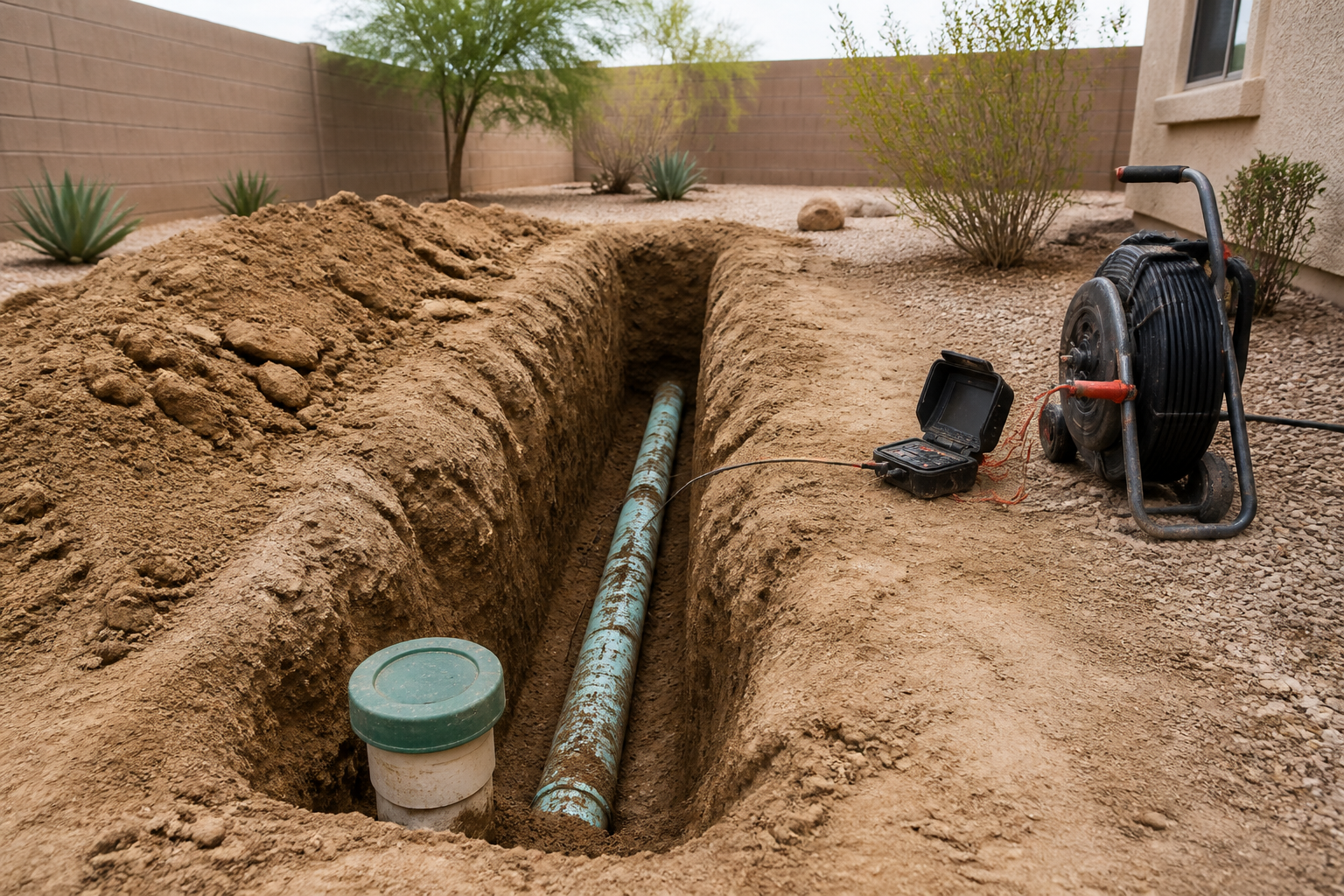
The sewer lateral carries waste from the house out to the main line. In most areas, including unincorporated Maricopa County communities such as Sun City West, the private lateral inside the property line is the owner's responsibility, and repairs on it need a licensed plumbing contractor and a permit.
Because the lateral is underground, damage is hidden until it causes a backup or a camera shows it. A line can be partly broken for years before it fails completely.
Tree roots enter at joints and cracks, then grow into a mass that catches waste. Older pipe materials such as clay can crack or separate at the joints. Orangeburg, a tar-and-fiber pipe used in some mid-century homes, can deform and collapse over time.
Sagging is another problem. If soil settles under the pipe, a low spot, or belly, forms where waste and water collect. Past repairs done badly, and heavy loads over the line, can also damage it.
Heavy monsoon rain can seep into a cracked lateral and overload the wastewater system during a storm. A cracked lateral lets groundwater and surface water into the line.
If more than one drain slows after heavy rain, mention that to the plumber. It points toward infiltration, and a camera inspection can show where.
A repair can be a small spot dig or a long section, and the price follows the scope.
Get the findings from the camera inspection in writing, and ask the plumber to show the footage of the damaged section.
A spot repair, or point repair, digs down to the damaged section, cuts it out and replaces it with new pipe. It suits a localized break. Pipe lining, sometimes called cured-in-place pipe, puts a resin-soaked liner inside the old pipe and cures it into a new pipe inside the old one. It avoids most digging and works when the pipe is structurally intact enough to hold the liner.
Orangeburg pipe, a tar-and-fiber material used in some mid-century homes, generally cannot be lined and needs replacement instead. A camera inspection tells you which material you have and which options are open.
A repair on a private lateral needs a permit and an inspection. The plumbing contractor normally pulls it. Ask whether the permit is included in the quote and how long the inspection usually takes.
Ask your local wastewater provider or homeowners association whether any assistance program exists for lateral repairs, since terms and availability change from one community to the next.
Sewer trouble can show up far from the break. Watch for these.
Three faults account for many failures. Roots enter at joints and grow into a mat that catches paper. A cracked joint lets soil in and slows flow. A sag, sometimes called a belly, holds water in a low spot so solids settle there.
Each has a different fix. Roots can be cut, but they return unless the joint is repaired. A crack may allow a spot repair. A sag usually needs the section replaced or relaid to the right slope.
Callers often ask whether to jet the line or repair it. A camera answers that. If the pipe is intact, jetting may be enough for a while. If the pipe is broken, jetting is only a pause.
Old pipe types add another wrinkle. The city says Orangeburg pipe has to be replaced and cannot be lined, so an inspection should identify the material before you pick a repair.
See inside the sewer line before you decide on a repair, a replacement or a home sale.
Replace the sewer lateral from the house to the property line when repair will not hold.
Clear kitchen, bath, laundry and main-line clogs and find out why they came back.
Common ones are multiple slow drains, gurgling, a sewer odor outdoors and clogs that keep returning. A camera inspection confirms what is wrong and where.
In some cases. Lining and some trenchless methods reduce digging, but they depend on the pipe's condition and material. Orangeburg pipe generally cannot be lined.
In most communities, including Sun City West, the owner is responsible for the private lateral inside the property line, while the wastewater provider looks after the main. Ask your provider if you are unsure where the boundary is.
Yes, repairs to a private lateral generally need a permit, and a licensed plumbing contractor should pull it.
Stop using sinks, tubs, toilets and the washer, since every gallon adds to the backup. Keep people and pets away from the affected area and call the 24/7 line. A contractor can clear the line first and then check it for damage.
Start with a camera if you can. If it shows a clean pipe with grease or roots, jetting may be enough. If it shows a break or a sag, repair is the real fix.
It is a section that has settled and holds water in a low spot. Solids collect there and cause repeat clogs. The usual fix is to replace or relay that section.
Sometimes. Cutting the roots clears the line, and a repair or liner at the joint can slow regrowth. A camera shows how many joints are affected.
Sun City West's guidance says Orangeburg must be replaced rather than lined. A camera or records review can confirm what pipe you have.
Ask for the camera findings first, then a quote for the repair option. The dispatcher can explain how the contractor prices spot repairs and longer sections.
Stop using extra water and call. A camera inspection is usually the first step.
Service area centered on Sun City West and nearby Maricopa County cities.